




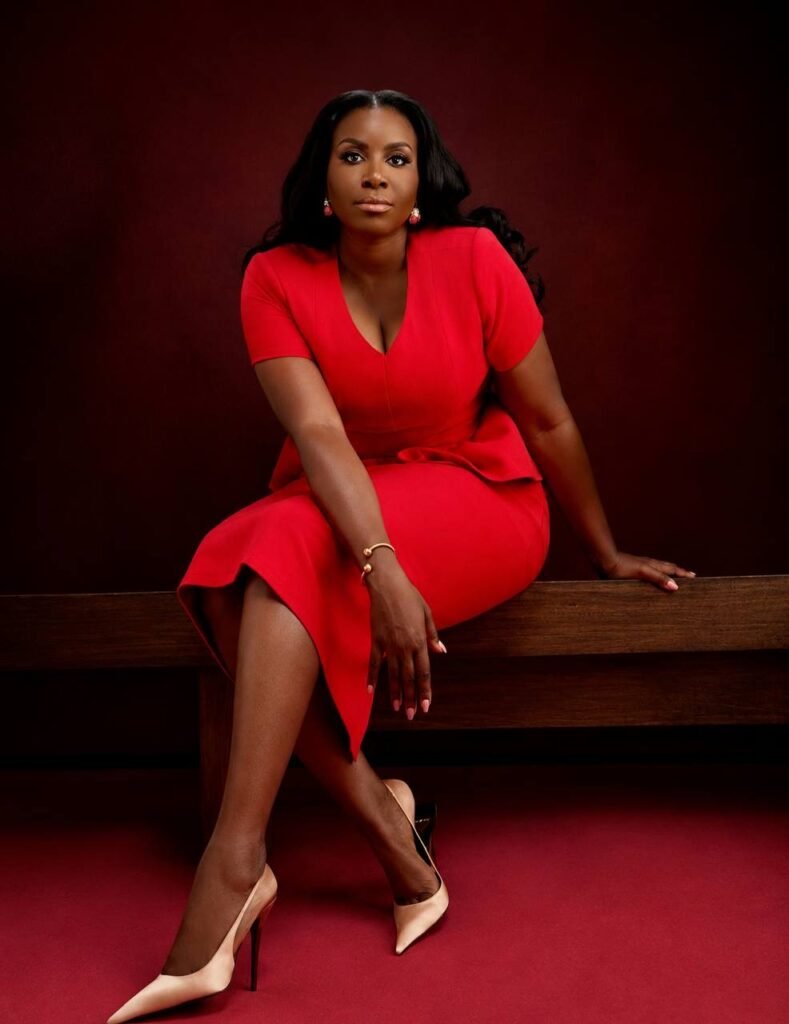
As African finance undergoes a profound transformation, a new generation of leaders is emerging—people who are not content with simply building companies, but are also determined to shape the conversations defining the continent’s economic future. Gillian Darko belongs firmly to this generation.

A lawyer by training, Gillian has built an impressive career across some of the world’s leading financial and professional institutions, including PwC and J.P. Morgan, before moving into Africa’s fast-growing fintech ecosystem through JUMO and, later, Yellow Card.
Today, her work is focused on the decisions that accompany the growth of ambitious companies. But her influence extends well beyond her formal responsibilities. Through industry forums, thought leadership and public speaking, she has become part of important conversations around innovation, regulation and the financial infrastructure Africa needs to sustain its economic transformation.
Her voice is now heard at platforms such as Forbes Africa, CNBC Africa, the Africa Financial Industry Summit (AFIS) and the McKinsey Africa Roundtable.
She did not build this platform overnight.
BUILD YOUR PLACE WITHOUT WAITING FOR IT TO BE GIVEN TO YOU
Before returning to Ghana, Gillian spent much of her professional life in the United Kingdom. She began her career at ICE Futures Europe before joining PwC, where she advised major global financial institutions including Goldman Sachs, HSBC, Citigroup and UBS on strategic issues.
She later continued her career with J.P. Morgan Asset Management, gaining experience in an environment where decisions are made at the highest levels of global finance.
In 2020, she made a defining decision: she returned to Ghana.
After several years in the United Kingdom, coming back to the continent meant entering a professional environment that was familiar in some ways but very different in others. Networks had changed. Business cultures were different. There were new relationships to build and new expectations to navigate.
Rather than relying solely on the credentials she had accumulated abroad, Gillian chose to prove herself through results.
That approach has remained central to the way she works.
Upon her return, she became General Manager, Market Operations (Africa) at JUMO and was subsequently appointed Chief Executive Officer of JUMO Ghana. These roles gave her the opportunity to bring her experience from major international financial institutions into direct conversation with the realities of African markets.
At Yellow Card, she initially served in a dual role as Chief of Staff and Director of Strategy before becoming Group Vice President, Strategy.
Her responsibilities have included corporate strategy, market expansion and the development of partnerships that support growth across multiple regions. Her work has taken her beyond Africa, with projects spanning Latin America, Asia and the Middle East.
At its core, however, she describes her role simply: figuring out how to grow companies.
WHERE FINANCE, TECHNOLOGY AND AFRICA MEET
Much of Gillian’s work today sits within the rapidly evolving world of stablecoins and virtual assets.
For Africa, this is more than a technology story. It is increasingly a question of how businesses move money, settle international transactions and participate in the global economy.
Stablecoins, particularly digital assets designed to maintain a stable value against currencies such as the US dollar, are creating new possibilities for cross-border payments, supplier settlements and the preservation of value. They offer a technological response to some of the challenges that traditional correspondent banking systems have struggled to solve efficiently.
Yet the technology itself is only one part of the equation.
The regulatory frameworks, infrastructure and institutional foundations supporting this ecosystem are still being developed. A relatively small group of experts is therefore helping shape an industry whose decisions today could influence African commerce for decades.
Gillian is increasingly part of that conversation.
She is also one of the relatively few women participating prominently in these discussions—a position she takes seriously. For her, representation is not simply about occupying a seat at the table. It is about contributing to the systems being designed and ensuring that the people shaping Africa’s financial future reflect the diversity of the continent itself.
Since 2025, Gillian has published several opinion pieces exploring stablecoins, digital-asset regulation and the economic sovereignty of African countries. Her position is clear: sustainable innovation cannot thrive without appropriate regulation and infrastructure designed around the realities of African markets.
Her ideas have also taken her onto major industry stages, where policymakers, investors and business leaders gather to debate the future of finance.
She has appeared at the Forbes Leading Women’s Summit, spoken on CNBC Africa and participated in events including GITEX Africa and the Africa Financial Industry Summit. She has also served on the steering committee of AFIS.
In 2026, her growing influence within the sector was recognised when the Ghana FinTech Awards named her FinTech Personality of the Year (Female).
LEADERSHIP AS SELF-AFFIRMATION
For Gillian, leadership begins with something deceptively simple: refusing to believe that success requires you to become someone else.
Throughout her career, she says she has sometimes been described as “aggressive” simply because she expresses her ideas with confidence. It is a label she believes women are still too often given when they demonstrate ambition, authority or certainty.
Over time, she stopped apologising for those qualities.
Instead, she began to see them as part of what has helped her progress.
That same philosophy extends beyond the boardroom.
Gillian has a strong interest in fashion and does not subscribe to the idea that professional credibility requires the erasure of personality. For her, style is another form of self-expression—no different from the way she communicates her ideas or approaches major decisions.
Her interests, however, extend well beyond fashion.
Art, interiors and design also feature prominently in her thinking. She is interested in the way physical spaces influence emotions, behaviour and human interaction. Even her appreciation of food and cooking is rooted less in the recipe itself than in the experience of bringing people together.
For Gillian, hospitality is about creating an environment in which people feel comfortable and valued. It is about the sequence of a dinner, the details that often go unnoticed and the thought behind the experience.
In many ways, she approaches hospitality in the same way she approaches markets: as a form of design in which people remain at the centre.
MAKING ROOM FOR THE NEXT GENERATION
Her commitment to expanding opportunities for women is also reflected in her involvement with Women in Payments Africa and Women in FinTech & Innovation Ghana.
Through these organisations, Gillian seeks to make careers in financial technology and related fields more visible to young women. More importantly, she wants them to understand that professional success does not require them to surrender their identity.
That message sits at the heart of her broader approach to leadership.
Gillian Darko’s ambitions now extend far beyond the operational responsibilities attached to her title. Through her writing, public speaking, industry engagements and work with professional organisations, she is building something larger: a platform from which she can influence how Africa thinks about finance, technology and economic development.
Her journey from international finance in the United Kingdom to the centre of Africa’s fintech conversation has given her both perspective and proximity to a rapidly changing industry.
But perhaps her most significant influence lies in the example she represents.
She is building a career on expertise, ambition and self-definition—and doing so without waiting for permission to occupy the space she believes she has earned.
Credits
Photography: Ohene Kay
Styling: Bbeystyling
Makeup: @ekuababeauty
Outfit: @yartelgh
Editorial reference: ELLE Afrique Francophone
Original social media and editorial credits retained from the supplied source.